Beginner's Guide to Partner Dancing
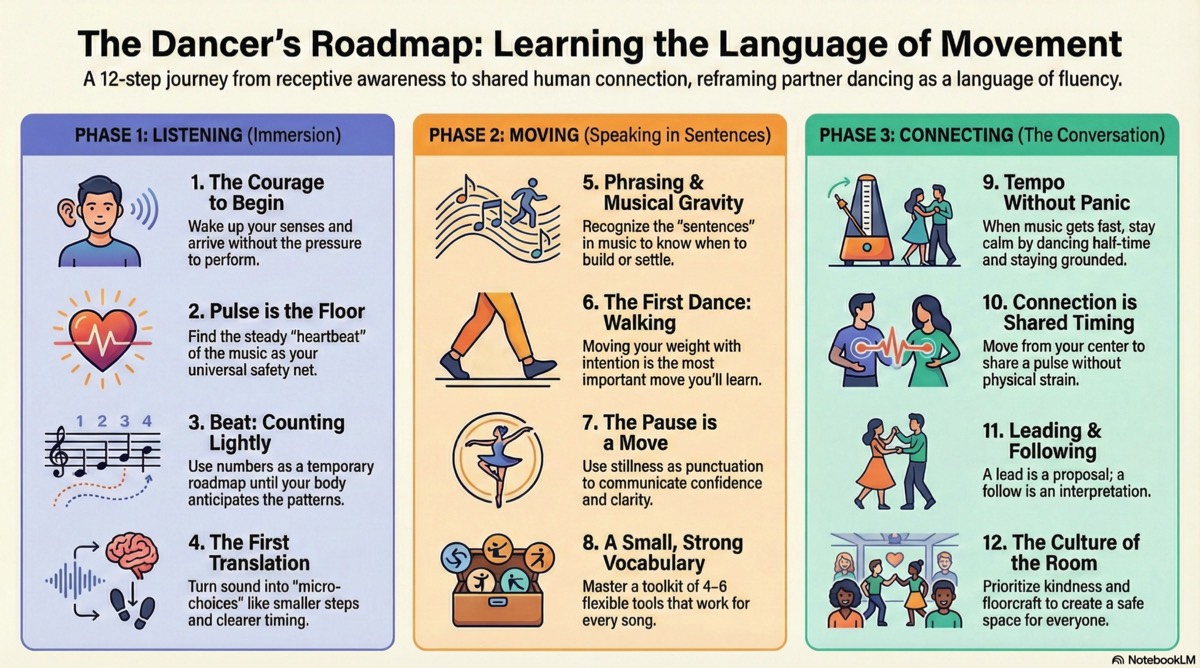
The Dancer’s Roadmap: Learning the Language of the Body
Welcome to the Series!
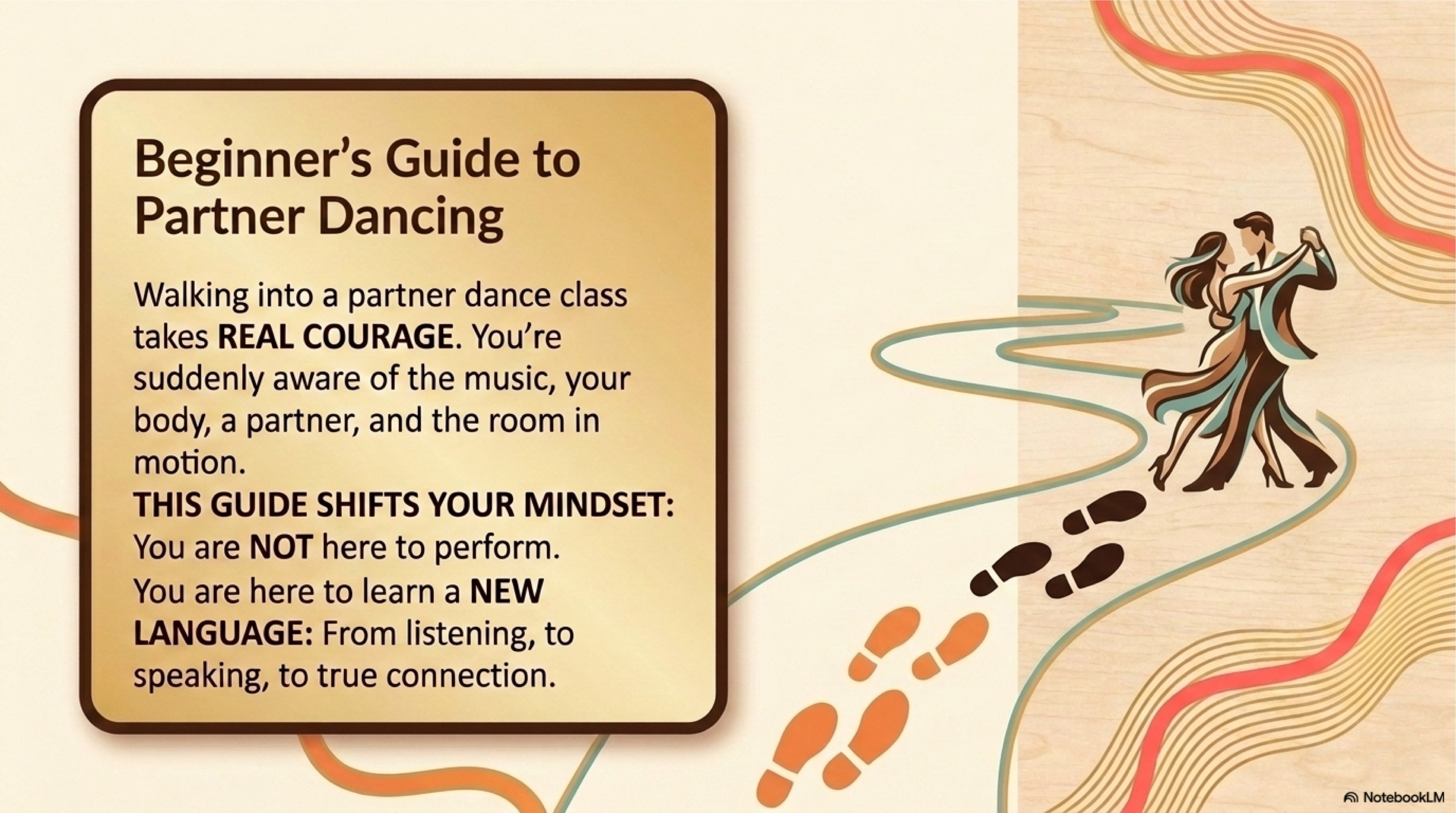
Walking into a partner dance class as an adult takes real courage. Suddenly, you’re aware of the music, your body, a partner, and a whole room in motion. It’s easy to feel unsure—but that just means your senses are waking up. You are a dancer—you’re just learning a new language.
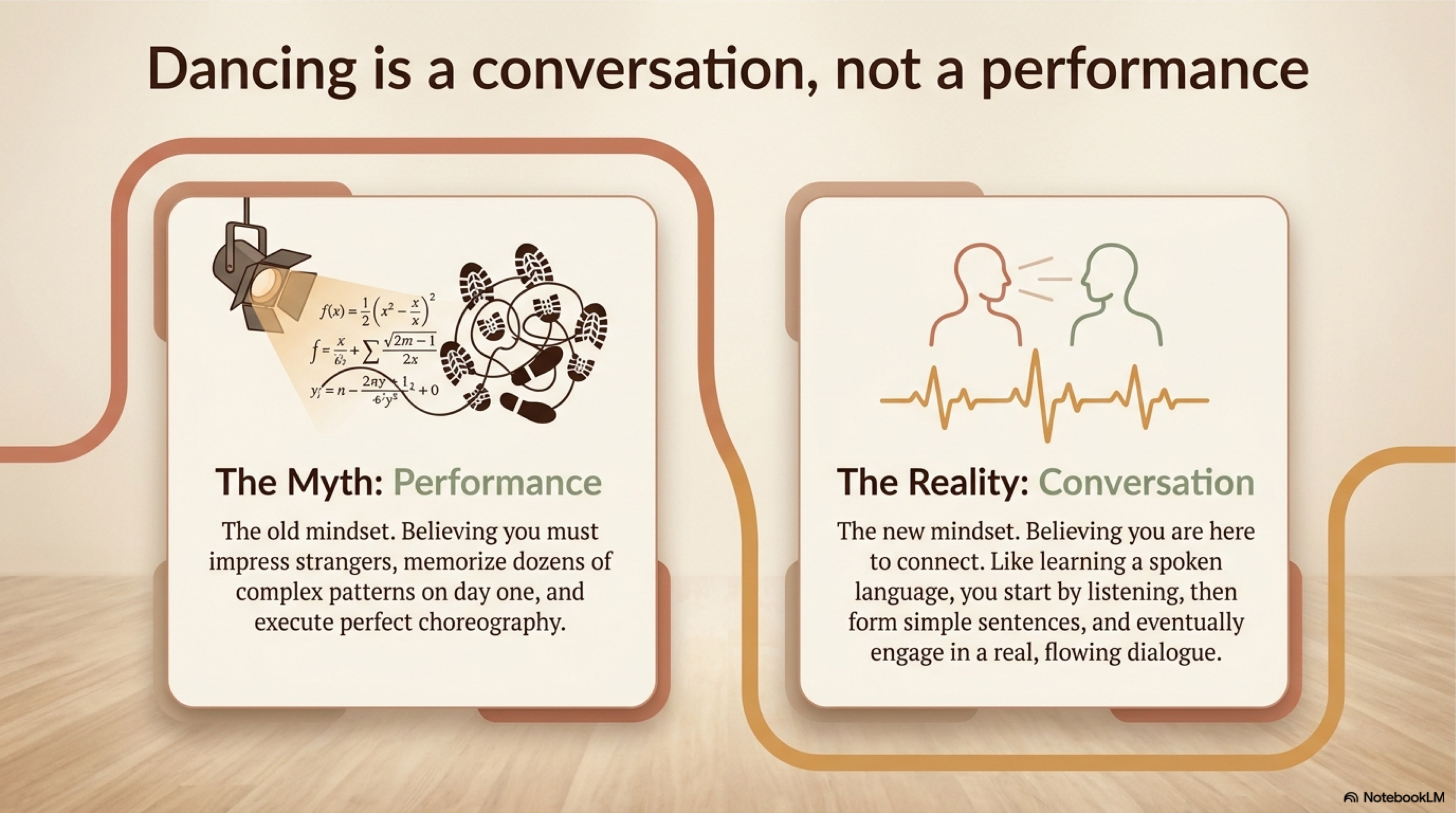
Dancing is a Conversation, Not a Performance.
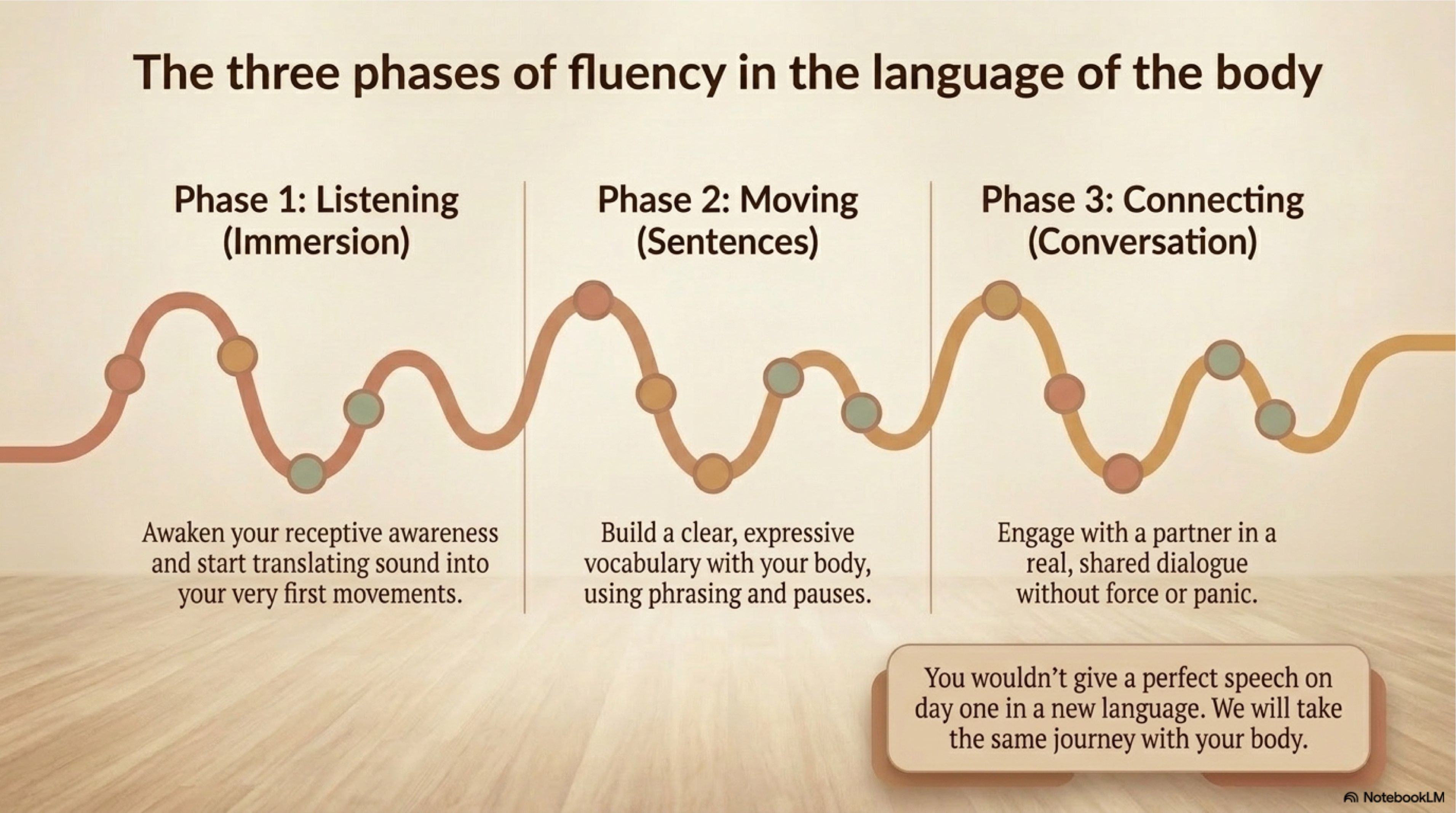
Think of dancing like learning to speak. You wouldn’t give a perfect speech on day one in a new language. First, you listen. Then, you form simple sentences. Eventually, you can have a real, flowing conversation.
We’ll take the same journey with your body—not to perform, but to connect.
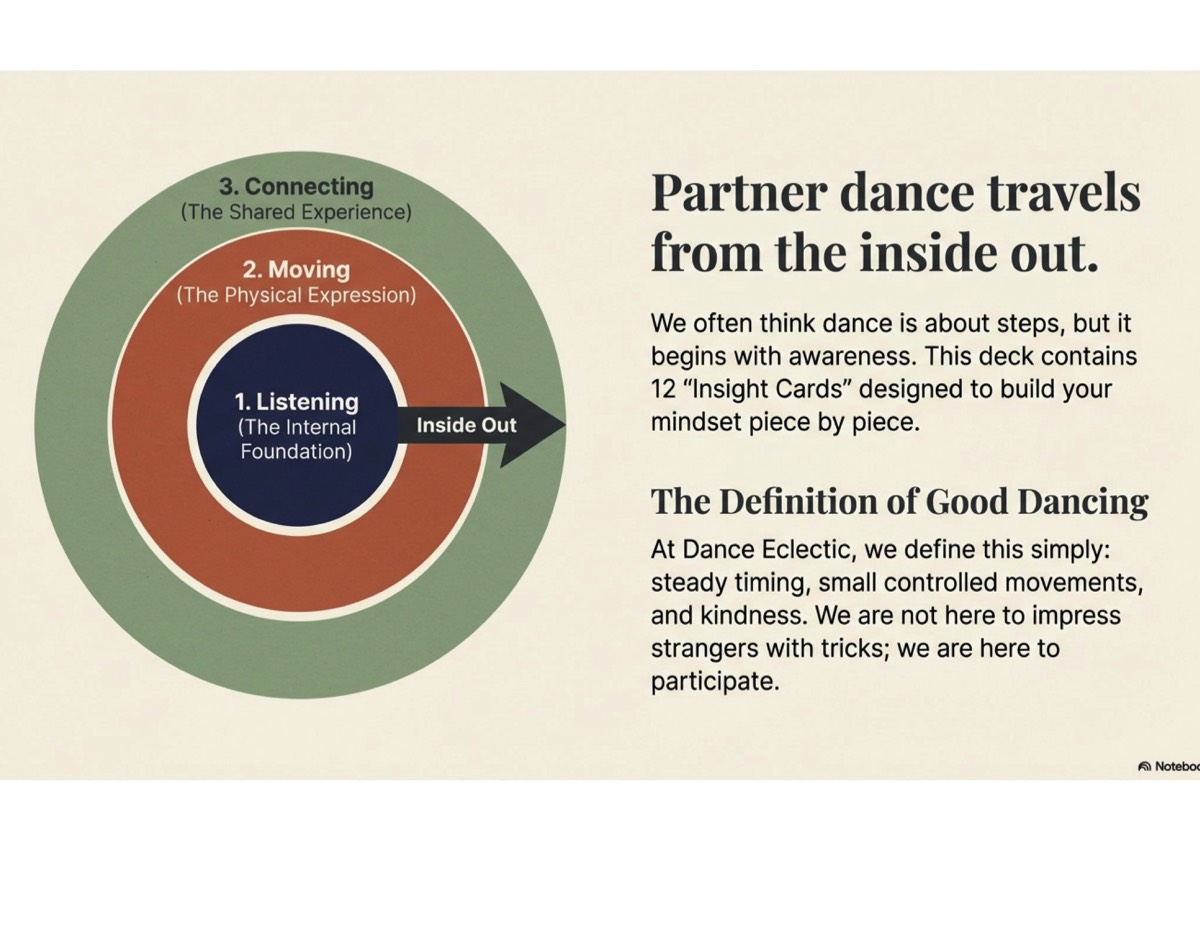
The 3 Phases of Fluency
Over the next 12 weeks, we’ll guide you from listening to moving to connecting, one simple step at a time.
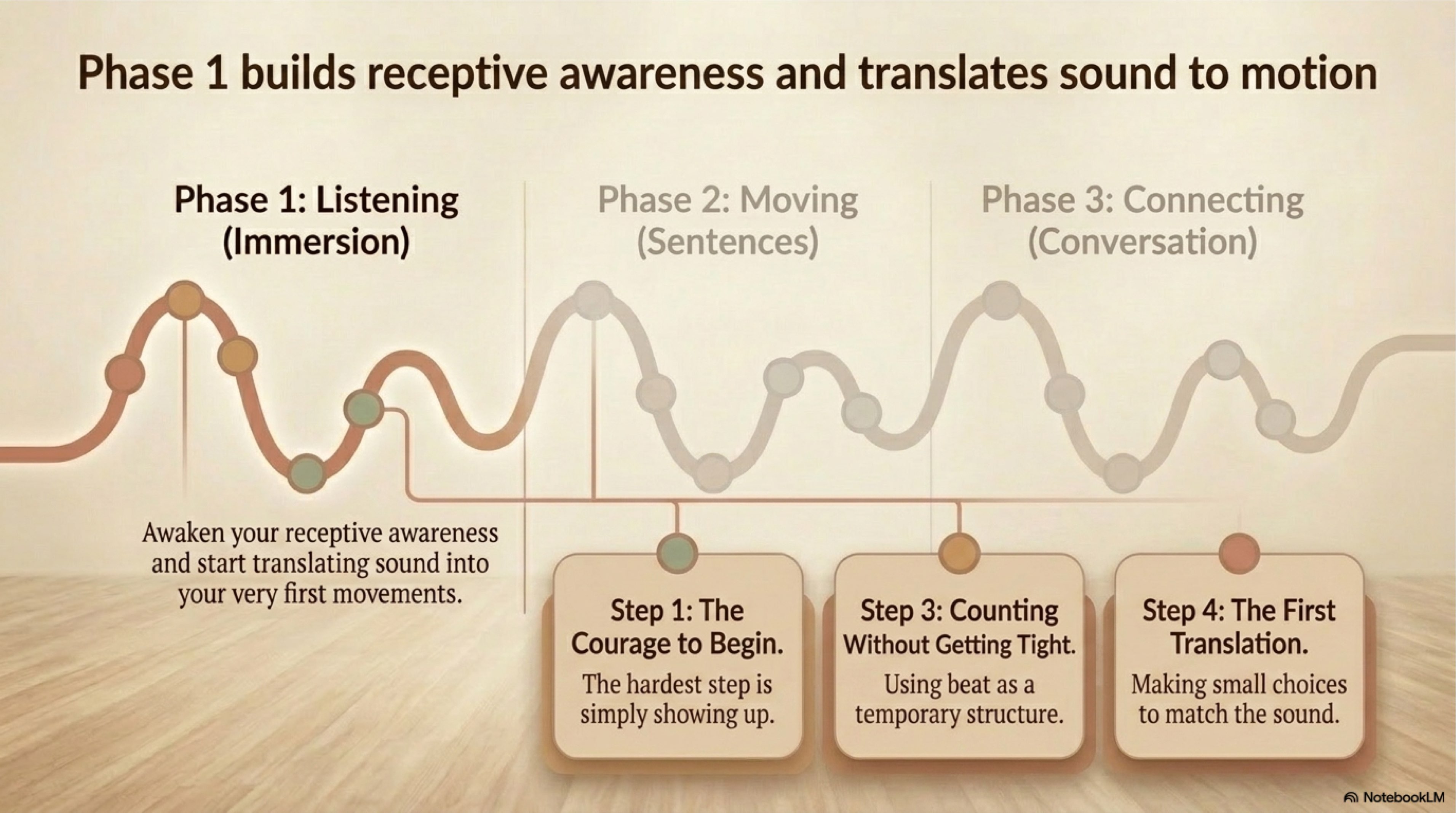
Phase 1: LISTENING (Immersion)
Awaken your awareness and start translating sound into movement.
1. The Courage to Begin
2. Pulse Is the Floor
3. Beat: Counting Without Getting Tight
4. The First Translation
Phase 2: MOVING (Speaking in Sentences)
Build a clear, expressive vocabulary with your body.
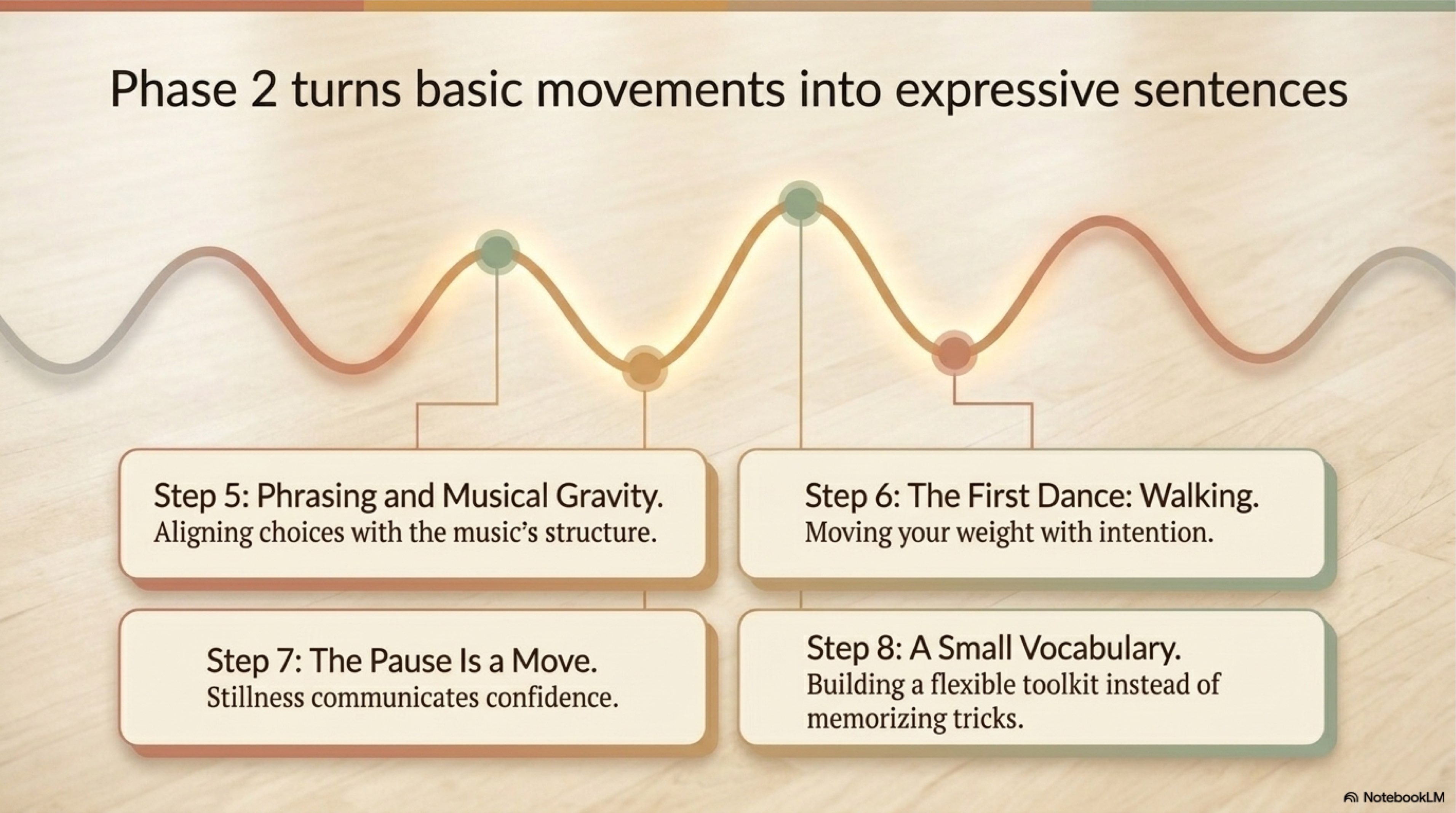
5. Phrasing and Musical Gravity
6. The First Dance: Walking
7. The Pause Is a Move
8. A Small Vocabulary
Phase 3: CONNECTING (The Conversation)
Engage with a partner in real, shared dialogue.
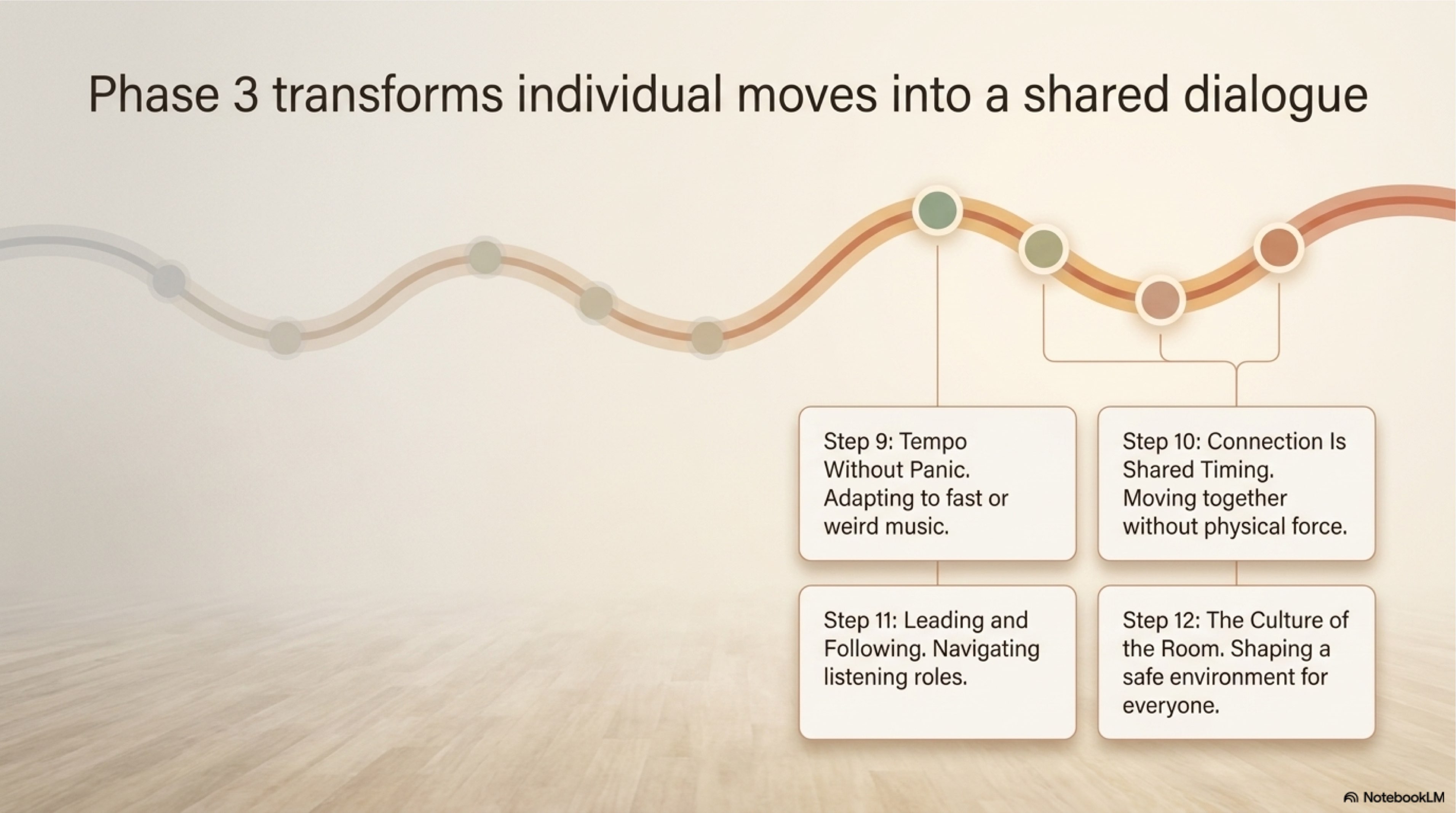
9. Tempo Without Panic
10. Connection Is Shared Timing
11. Leading and Following
12. The Culture of the Room
⸻
How It Works
Each week, you’ll get a short essay exploring one sstepof the journey. We’ll show you where it fits on the Roadmap so you can see the big picture.
This week, just take a look at the Roadmap.
Next week, we begin with Step 1: The Courage to Begin.
Step 1. The Courage to Begin

Listening: The Courage to Begin.
Walking into a partner dance as an adult takes real courage. Suddenly you’re aware of the music, your own body, a partner, and a whole room in motion. It’s easy to feel unsure—but that doesn’t mean you’re “bad at dancing.” It usually means something good: your senses are waking up. You’re not an outsider. You’re a dancer learning a new language, one song at a time.
Here’s the big idea behind this series:
Dancing is a Conversation, Not a Performance.
Think of learning to dance like learning to speak a new language. You wouldn’t try to deliver a perfect speech on day one. First you listen. Then you learn a few simple phrases. Eventually you can have a real, flowing conversation. We’re going to take that same journey with your body—not to impress anyone, but to connect.
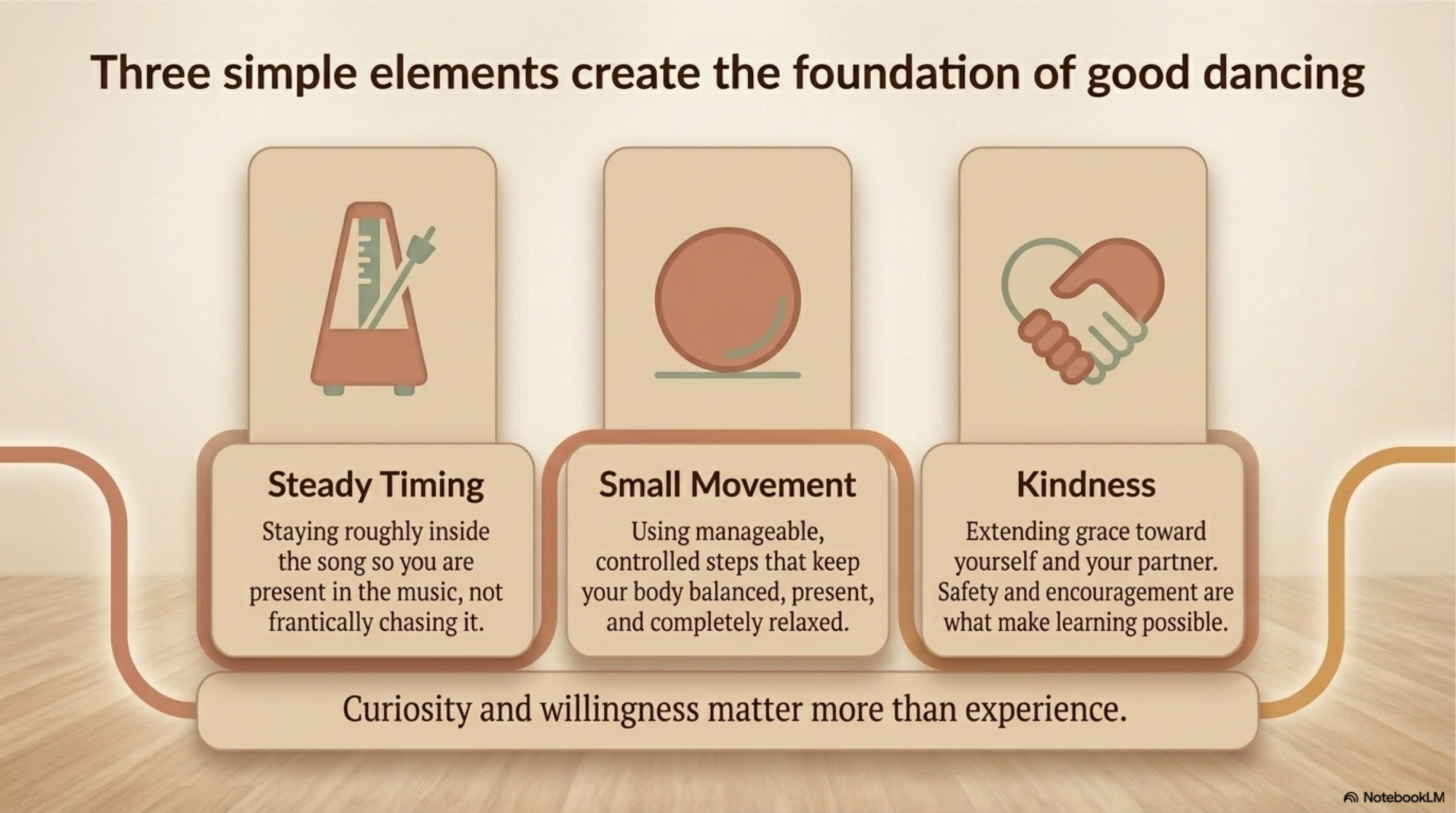
So what does “good dancing” mean at the beginning? Not fancy moves. Not big patterns. Not getting everything right. In the first phase, good dancing is built from three simple things:
• Steady timing — staying roughly with the music so you’re inside the song, not chasing it.
• Small, controlled movement — manageable steps that keep you balanced, present, and relaxed.
• Kindness — toward yourself and your partner, because safety and encouragement are what make learning possible.
If you bring those three qualities to the floor, you are already dancing. And once that mindset is in place, we can move from nervousness to the most reliable starting point of all: finding the pulse of the music and letting it carry you.
Step 2. Pulse is the Floor
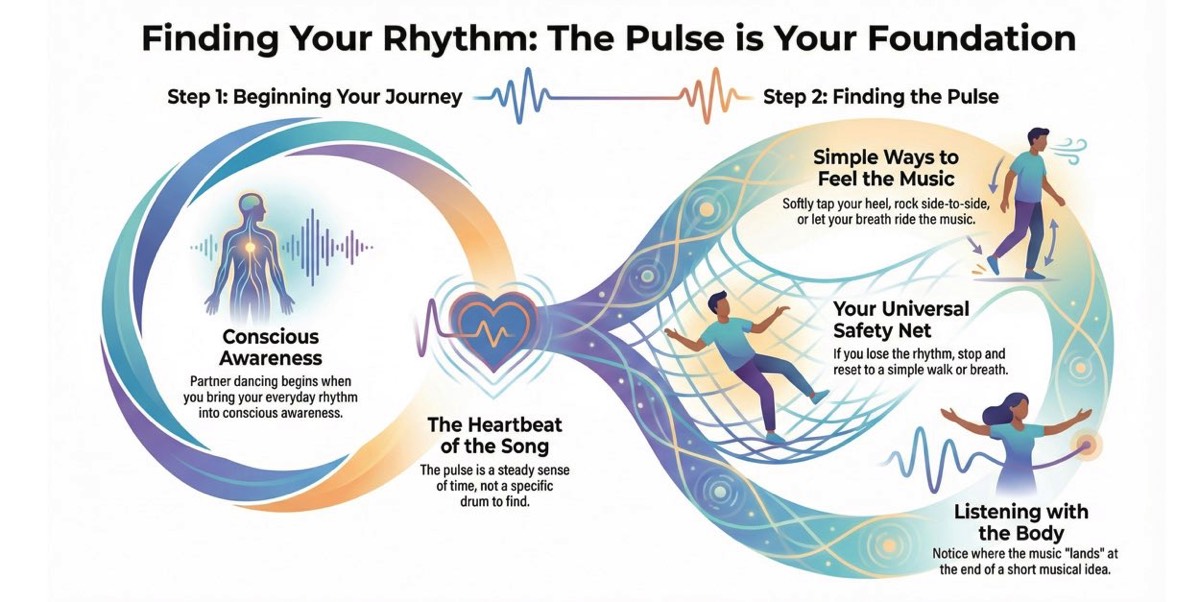
Pulse Is the Floor
(Receptive listening to the music)
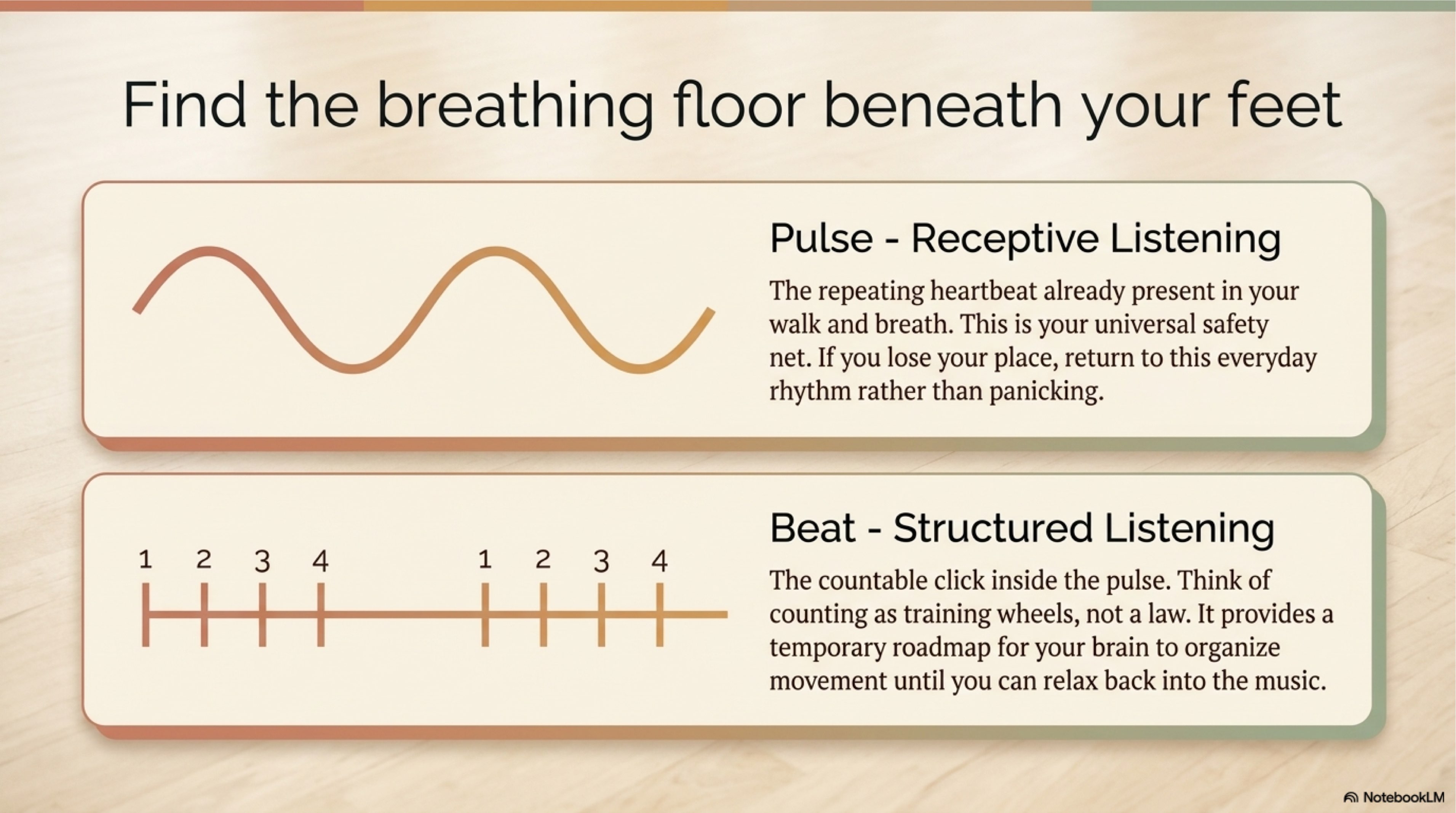
Before you worry about steps, you learn to feel pulse—the repeating heartbeat of the song that makes you want to sway, tap, or nod along. Pulse is not a special drum you have to “find” correctly; it’s the steady sense of time that’s already in your walk, your breath, and your heartbeat. Partner dancing begins when you bring that everyday sense of rhythm into conscious awareness.
There are many easy ways to feel pulse. You might softly tap your heel, walk slowly in place, or let your weight rock gently side to side. Some people connect through breath, letting their inhale and exhale ride the shape of the music. Others notice where the music “lands” at the end of a short musical idea—those landings are often where pulse feels clearest. None of these have to look like dancing yet; they’re simple experiments in listening with your body.
When the song feels strange or complex and you lose the pulse, your job isn’t to panic—it’s to reset. Stop what you’re doing, listen again for that steady heartbeat, and return to a simple walk, weight shift, or breath. Think of “return to pulse” as your universal safety net. As long as you can feel pulse, you have a way to be in the dance.
Step 3. Beat: Counting Without Getting Tight
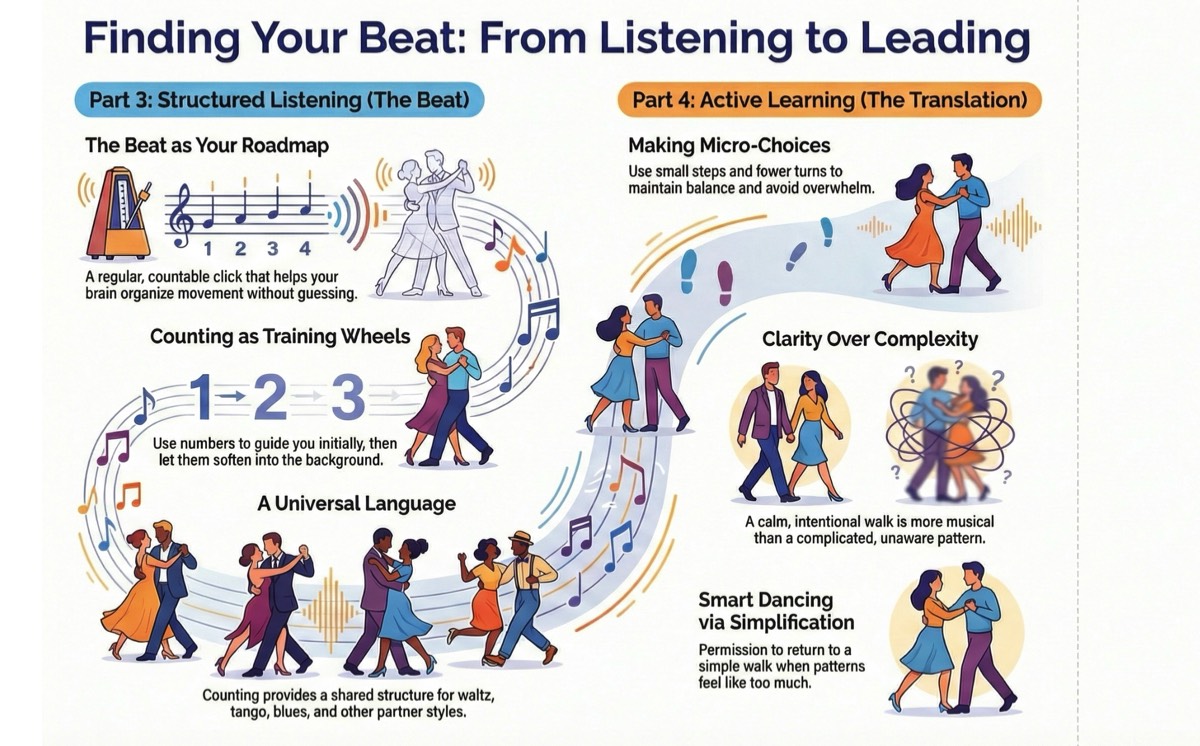
Beat: Counting Without Getting Tight
(Structured listening)
Once pulse feels familiar, you can zoom in a little: that’s where beat comes in. Beat is the regular, countable click inside the pulse—1, 2, 3, 4—that helps your brain organize movement in time. Counting isn’t there to make you stiff or “mathematical.” It’s there to give you a clear, temporary structure so your body can learn patterns without guessing.
When you learn a basic step, counting becomes your roadmap. It tells you when to step, when to pause, and when a pattern begins and ends. This turns a confusing blur of motion into something repeatable and reliable. The important attitude is lightness: count just enough to guide yourself, then let it soften. Think of counting as training wheels rather than a law.
Over time, your body starts to anticipate the steps before you consciously count them. The numbers fade into the background, and you find yourself moving on time without thinking about it. Beat has done its job. Whether you’re doing a waltz box, a tango walk, or a simple blues pattern, beat gives you a shared language with partners and teachers across dances. From there, you can relax into the music instead of clinging to the numbers.
Step 4 – The First Translation: From Sound to Motion
The First Translation: From Sound to Motion
(Active learning begins)
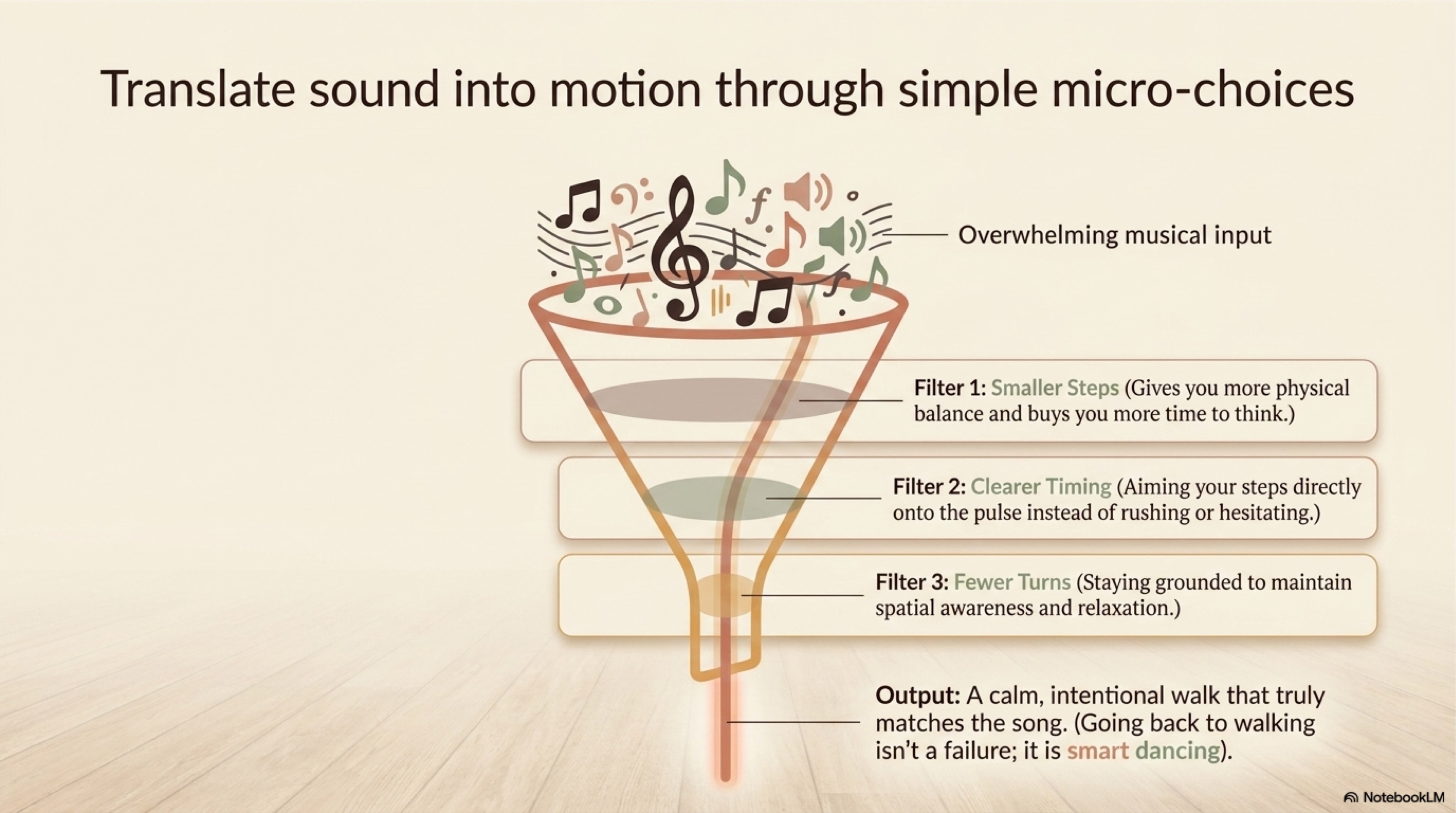
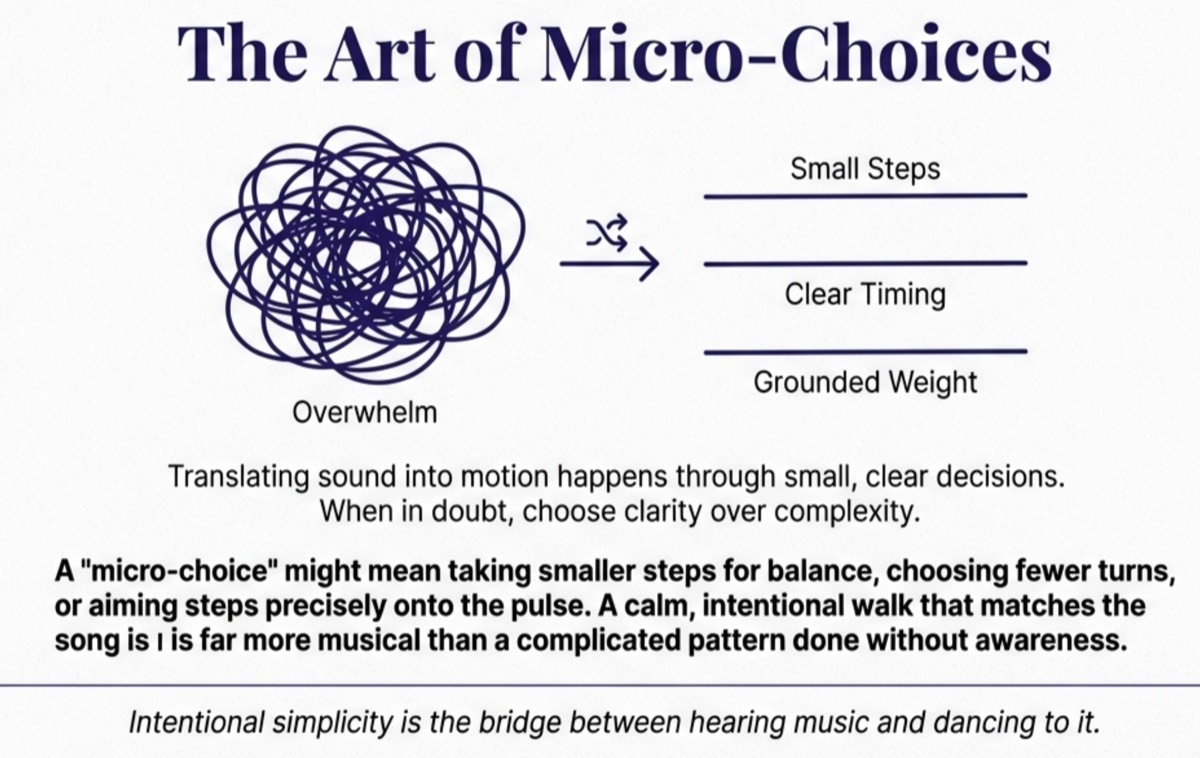
Now you start doing something powerful: turning what you hear into choices you make with your body. This is the first real “translation” from sound to motion. You don’t need big, fancy moves for this. In fact, the best way to learn is through what we might call micro-choices—small, clear decisions that keep you steady and out of overwhelm.
Those micro-choices are simple but effective: choose smaller steps so you have more balance and more time. Choose clearer timing, aiming your steps right onto the pulse instead of rushing or hesitating. Choose fewer turns at first so you can focus on staying grounded and relaxed. Give yourself permission to simplify a pattern if it feels like too much—going back to walking isn’t a failure; it’s smart dancing.
Musicality doesn’t begin with spins or dips. It begins with feeling pulse, managing your weight, noticing your breath, and responding to the phrasing of the music. A calm, intentional walk that truly matches the song is more musical than a complicated pattern done without awareness. Every time you choose clarity over complexity, you’re strengthening your ability to “speak” with the music.
Step 5 Phrasing and Musical Gravity
Phrasing and Musical Gravity (Speaking in simple sentences)
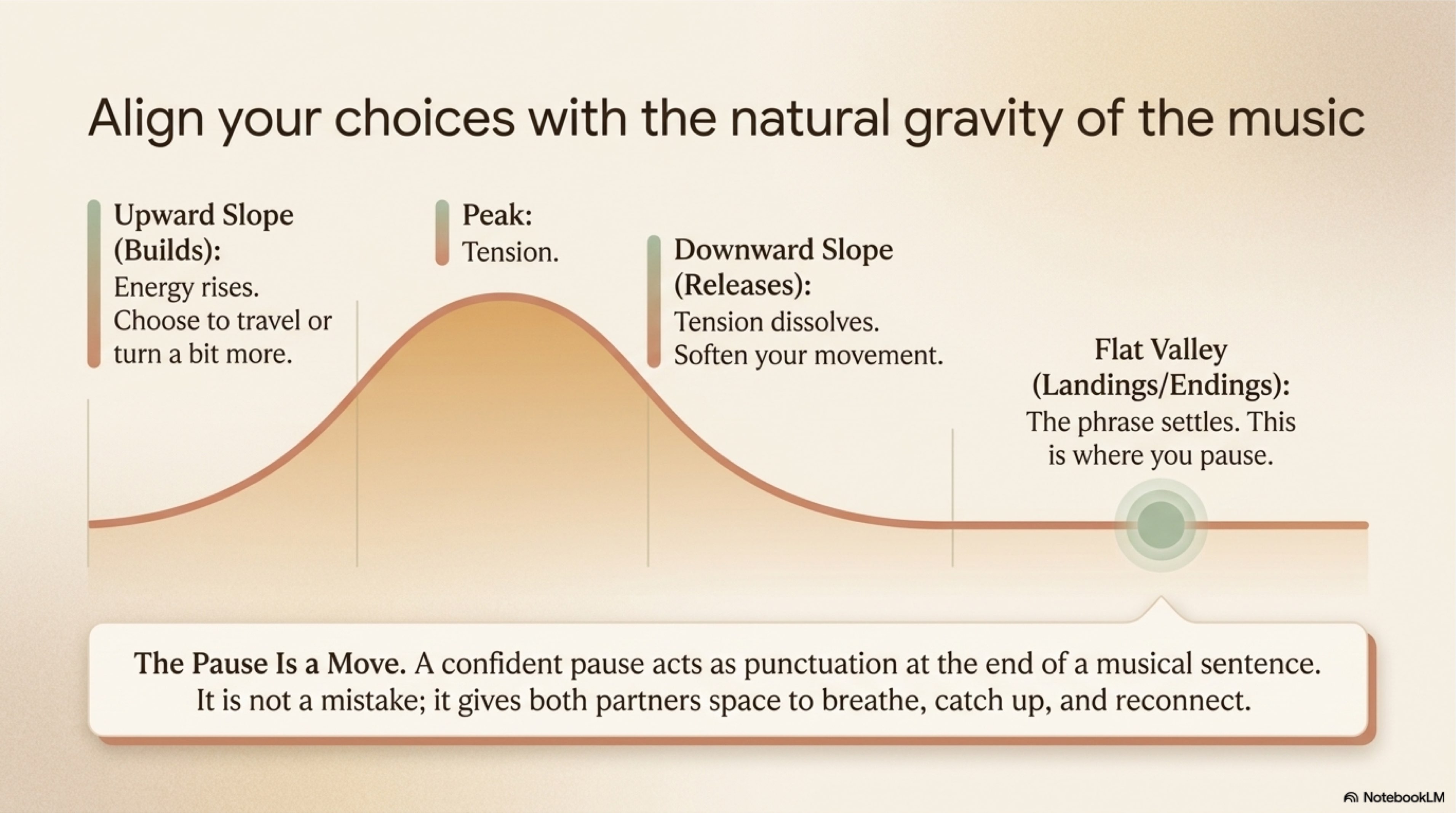
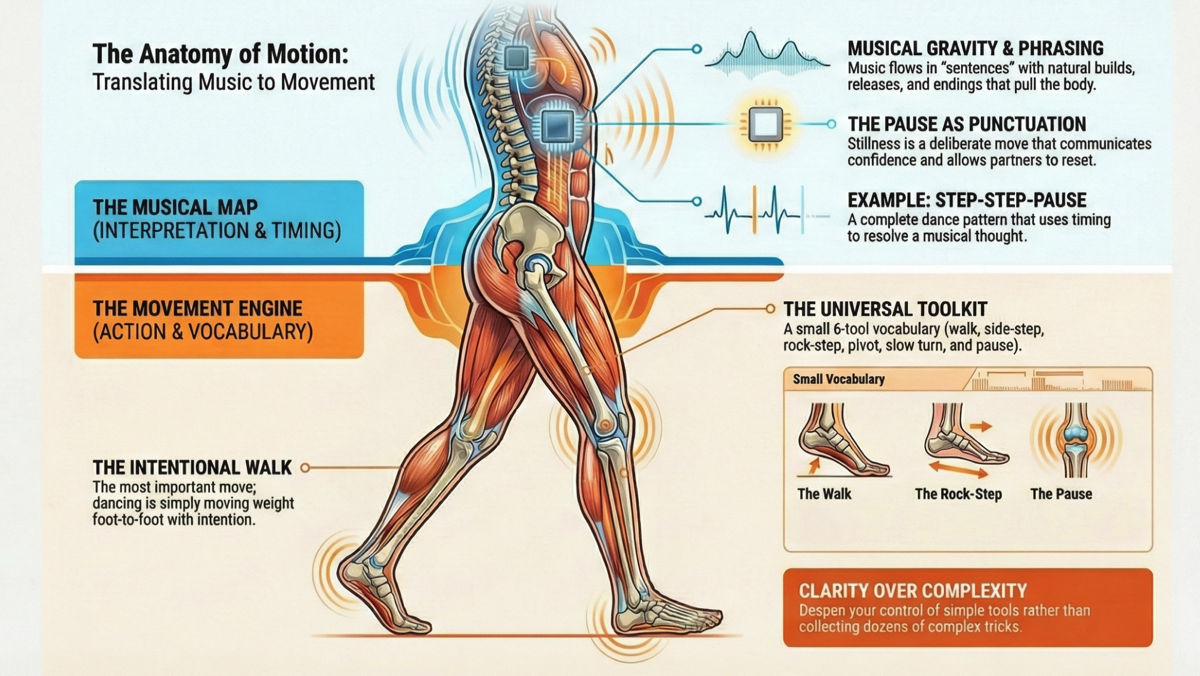
Music is not just an endless stream of sound; it comes in phrases, like sentences in a story. Even if you don’t know music theory, you can feel where things build, settle, and end. Some parts feel like questions, some like exclamation points, and some like a period at the end of a thought. This natural rise and fall is what we can call musical gravity—it pulls your body toward certain moments. As you listen, you start to notice landings (places the music feels settled), builds (a sense of energy rising), releases (where tension dissolves), and endings (clear points of closure).
When you’re aware of these shapes, you can place your movement more intentionally. You might choose to travel or turn a bit more when the music builds, then soften or pause when it releases. You’re no longer just staying on time; you’re aligning your choices with the music’s structure.
The pause becomes one of your most powerful tools. A small, confident pause at the end of a phrase reads as punctuation, not as a mistake. It gives you and your partner space to breathe, reconnect, and feel the music resolve—especially when the song is unfamiliar. Even with limited steps, responding to phrasing lets you “say” something with your dancing. You’re starting to speak simple, clear sentences in the language of the music.
step 6 The First Dance: Walking
The First Dance: Walking (Movement as interpretation)
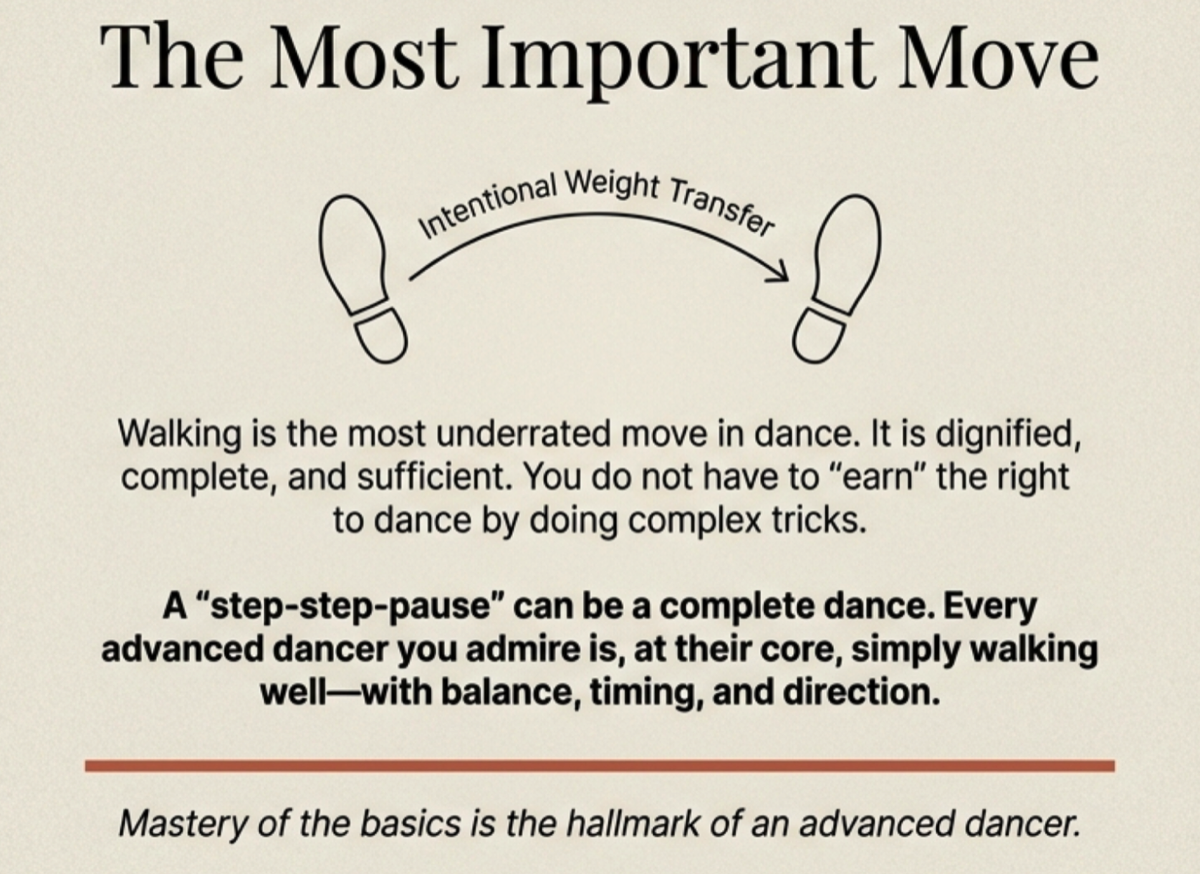
Walking is the most underrated dance move you’ll ever learn. At Dance Eclectic, it’s also the most important one. Tango walk, blues walk, waltz glide, “eclectic walk”—they’re all variations on the same truth: moving your weight from foot to foot with intention is dancing. Step-step-pause can be a complete dance all by itself.
When you allow walking to be a real dance, a lot of pressure melts away. You don’t have to “earn” the right to dance a whole song. From day one, you can walk with pulse, pay attention to your partner, and use pauses as part of your expression. You can dance entire evenings with mostly walking and still be musical and connected.
Framing walking as dignified changes how you show up. Instead of thinking, “I’m just doing basics,” you recognize that you’re practicing the heart of partner dancing: balance, timing, direction, and presence. Every advanced dancer you admire is still, at their core, walking well.
Step 7 The Pause is the Move
The Pause Is a Move
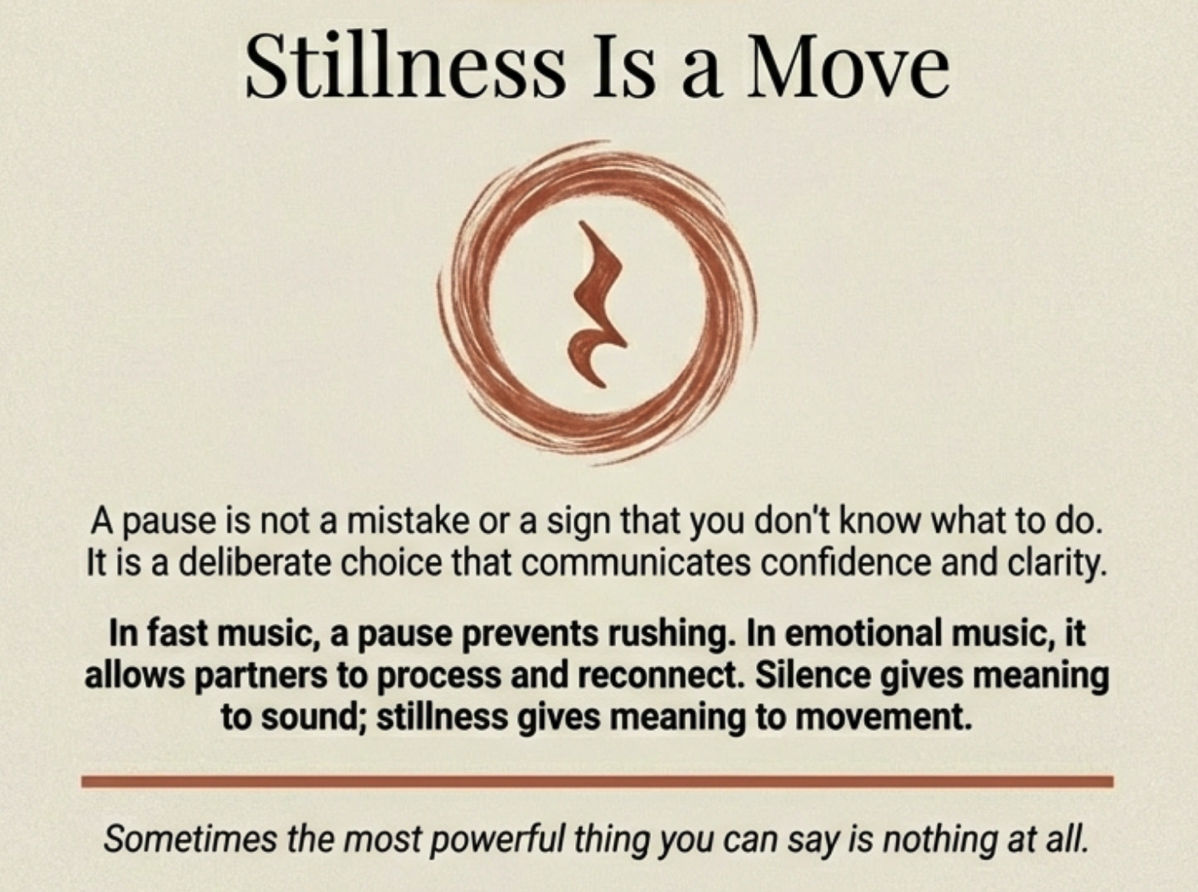
Pauses can feel scary at first, because they seem to say, “I don’t know what to do next.” This is a myth. In reality, a pause is a deliberate part of the dance. Stillness communicates confidence, clarity, and listening. When you pause, you give the music, your body, and your partner a moment to catch up to each other.
Pauses are deeply connected to phrasing, safety, and connection. In busy or fast music, a pause prevents rushing and collisions. In emotionally intense music, a pause lets both partners process and respond instead of just powering through. In partnership, a pause is often when you most clearly feel that you’re actually together—breathing, balancing, and listening in the same moment.
When you start treating pauses as moves, not mistakes, your whole dancing changes. You become more relaxed, more precise, and more expressive. You discover that sometimes the most powerful thing you can “say” in the dance is to not move for a beat or two.
Step 8 Small Vocabulary That Works Everywhere
Small Vocabulary That Works Everywhere
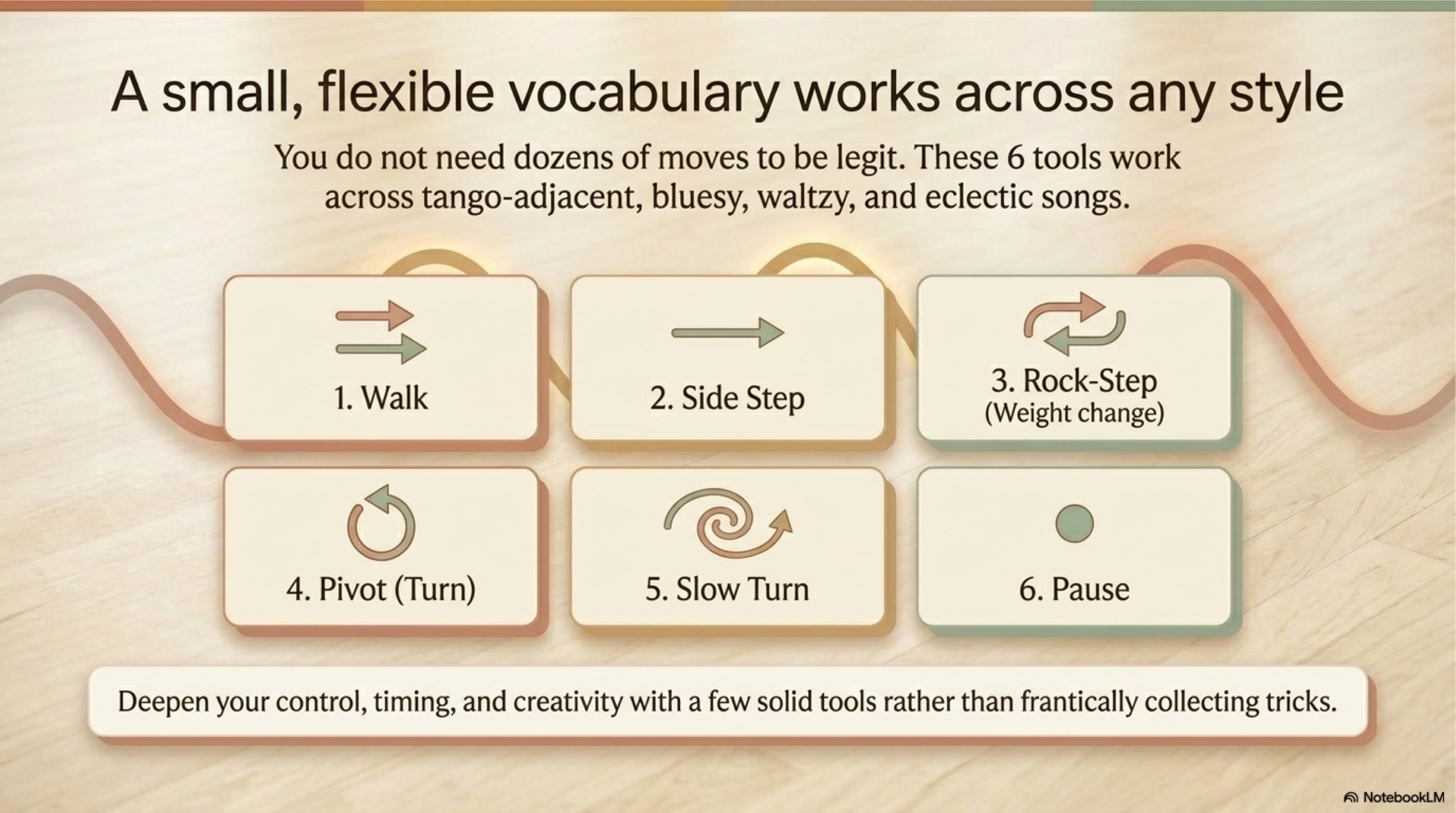
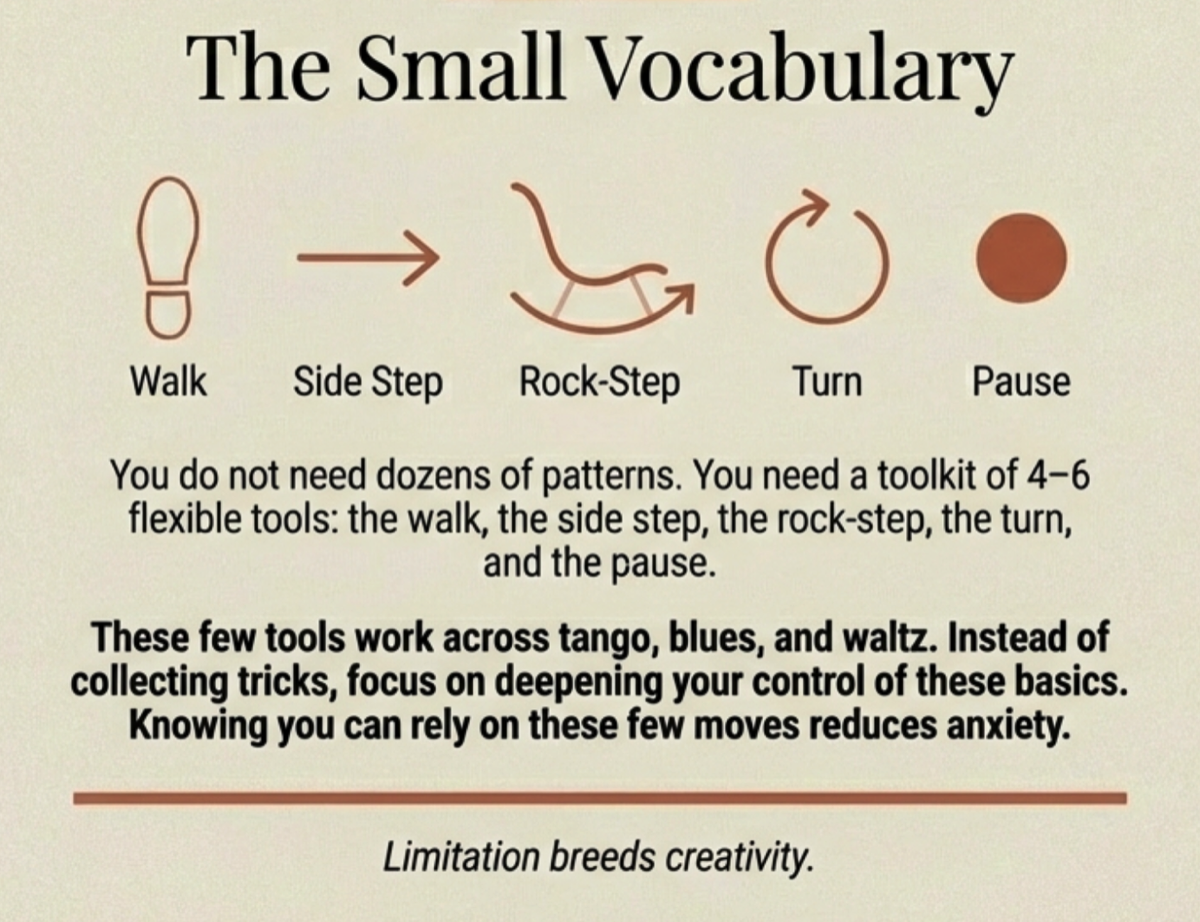
The dance world can make it seem like you need dozens of moves to be “legit.” This series takes a different view. You can do an enormous amount with a small, flexible vocabulary: walk, side step, rock-step or weight change, pivot or turn, slow turn, and pause. These 4–6 tools work across tango-adjacent, bluesy, waltzy, and eclectic songs.
Some classes teach long, detailed patterns with lots of counting. Here, the focus is on learning a pattern just well enough that your body recognizes it, then letting Ait become expressive through pulse and phrasing. You’re not trying to memorize everything; you’re building a toolkit. Once you know what a rock-step feels like, you can speed it up, slow it down, or tuck it into different parts of the music.
This is incredibly freeing. Instead of thinking, “I don’t know enough moves for this song,” you can think, “I know how to walk, side, turn, and pause—and that’s enough to start.” Your progress becomes less about collecting tricks and more about deepening your control, timing, and creativity with a few solid tools.
Step 9 Tempo Without Panic
Tempo Without Panic
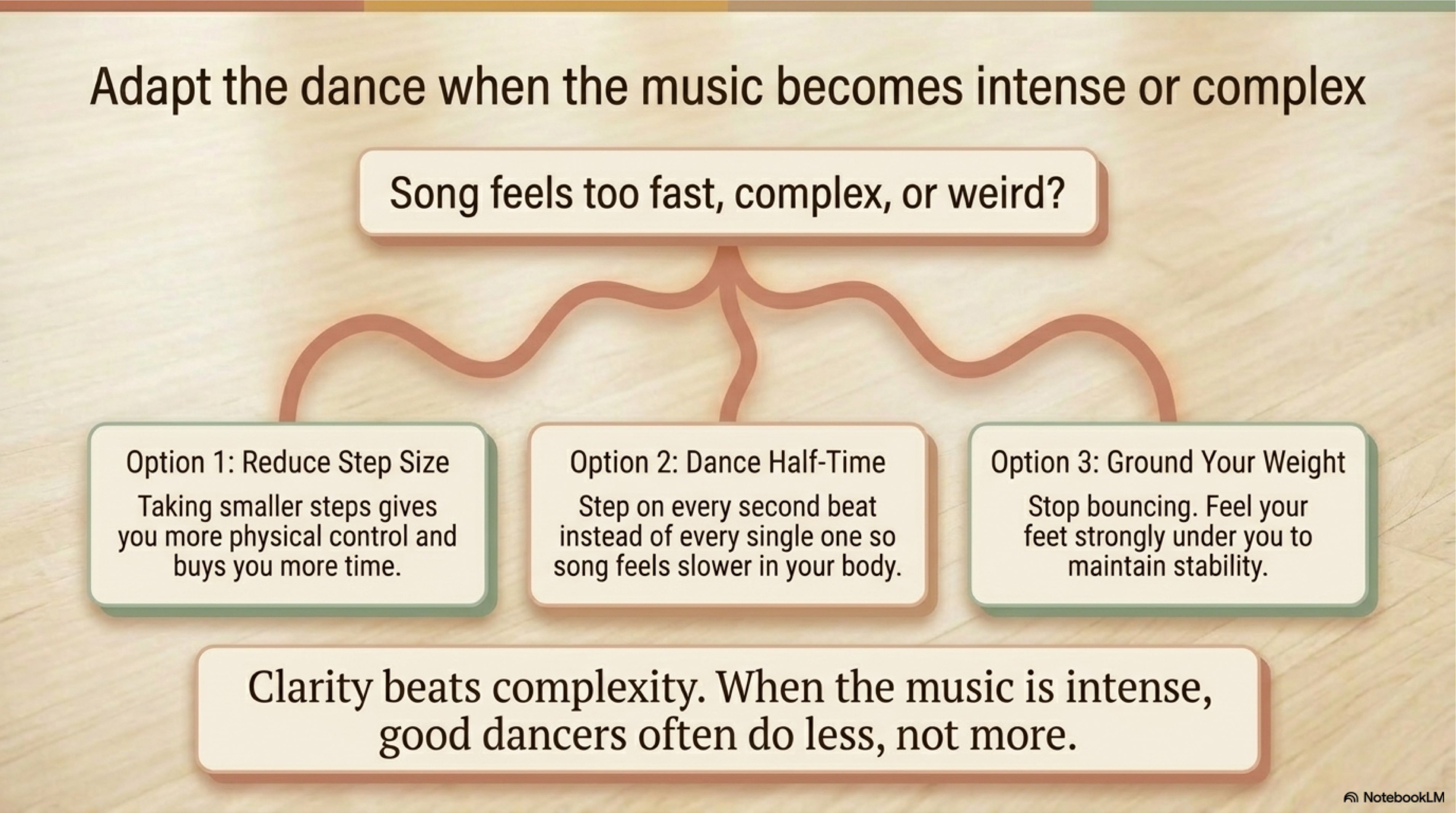
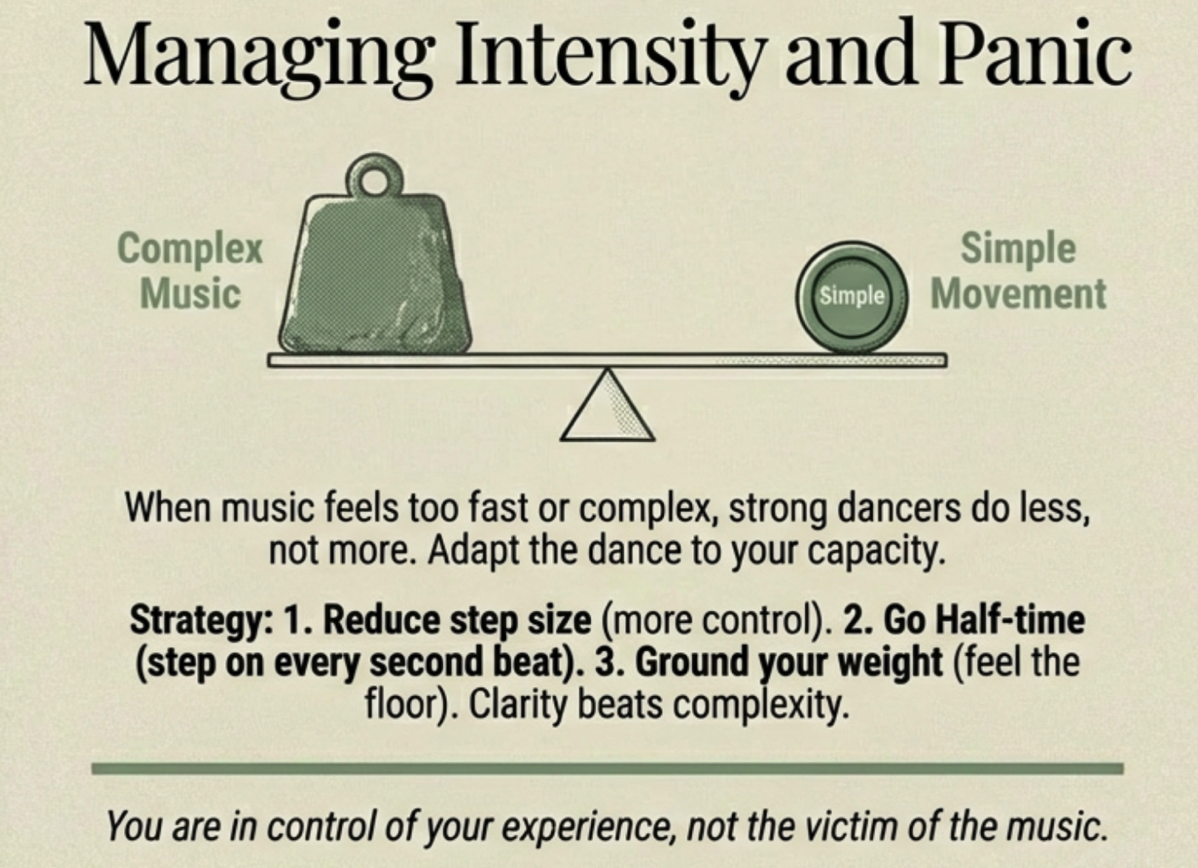
At some point, you’ll meet a song that feels way too fast, too complex, or just plain weird. Your brain may want to say, “I can’t dance to this.” But you have options. Strong dancers don’t force themselves to match every tiny sound; they adapt the dance to what they can handle clearly.
Three strategies help immediately. First, reduce step size: small steps give you more control and more time. Second, dance half-time—step on every second beat instead of every single one so the song feels slower in your body. Third, keep your weight grounded; feel your feet strongly under you rather than bouncing around.
When in doubt, choose the simplest combo: pulse, walking, and pause. You can also simplify the partnership—less turning, more straight lines. An important mindset shift: when the music is intense, good dancers often do less, not more. Clarity beats complexity. A calm, grounded walk that honestly fits the music will always feel better than frantic steps that try to keep up with every note. You’re allowed to choose what level of intensity you participate in.
Step 10 Connection Is Shared Timing
Connection Is Shared Timing
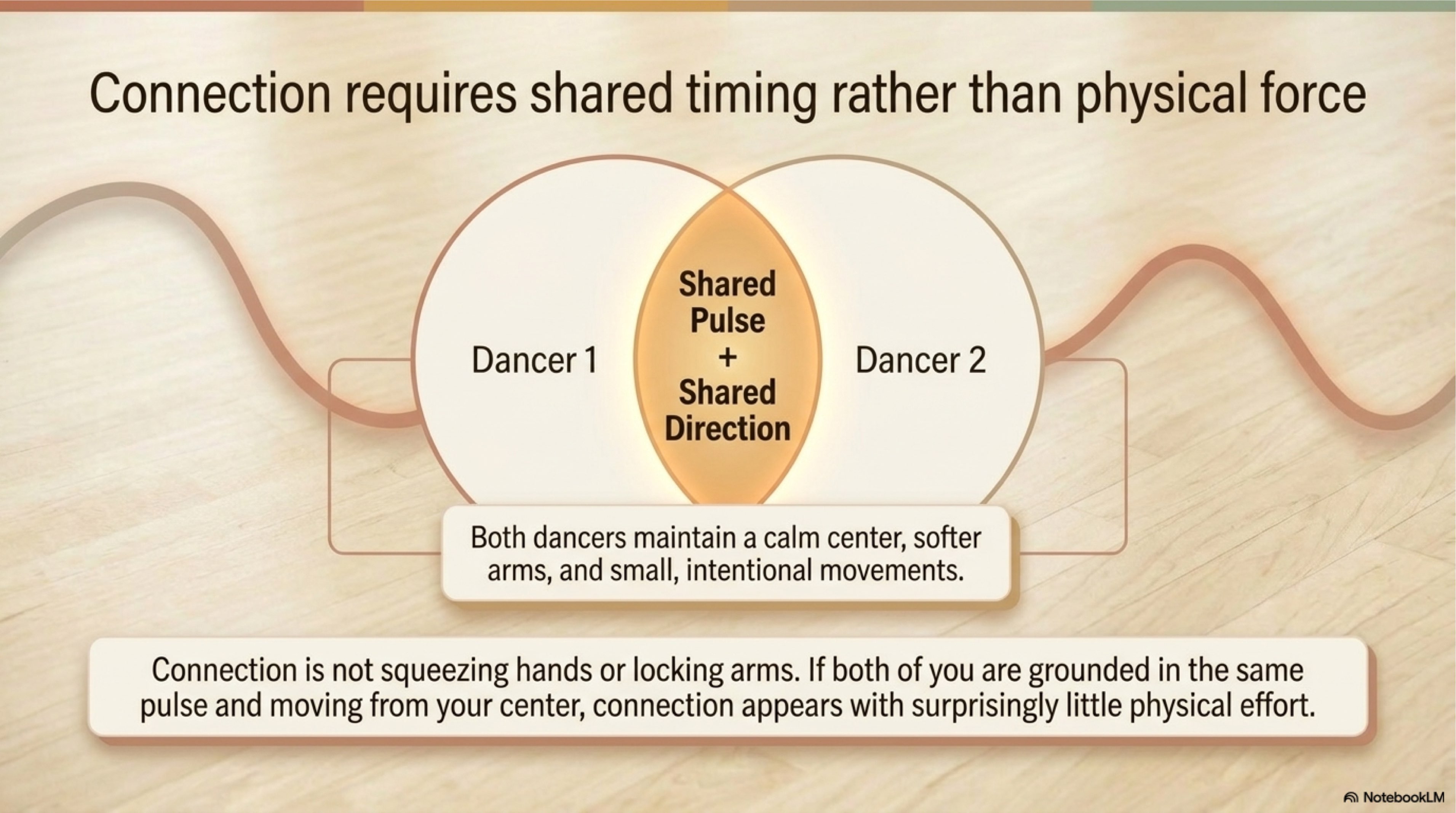
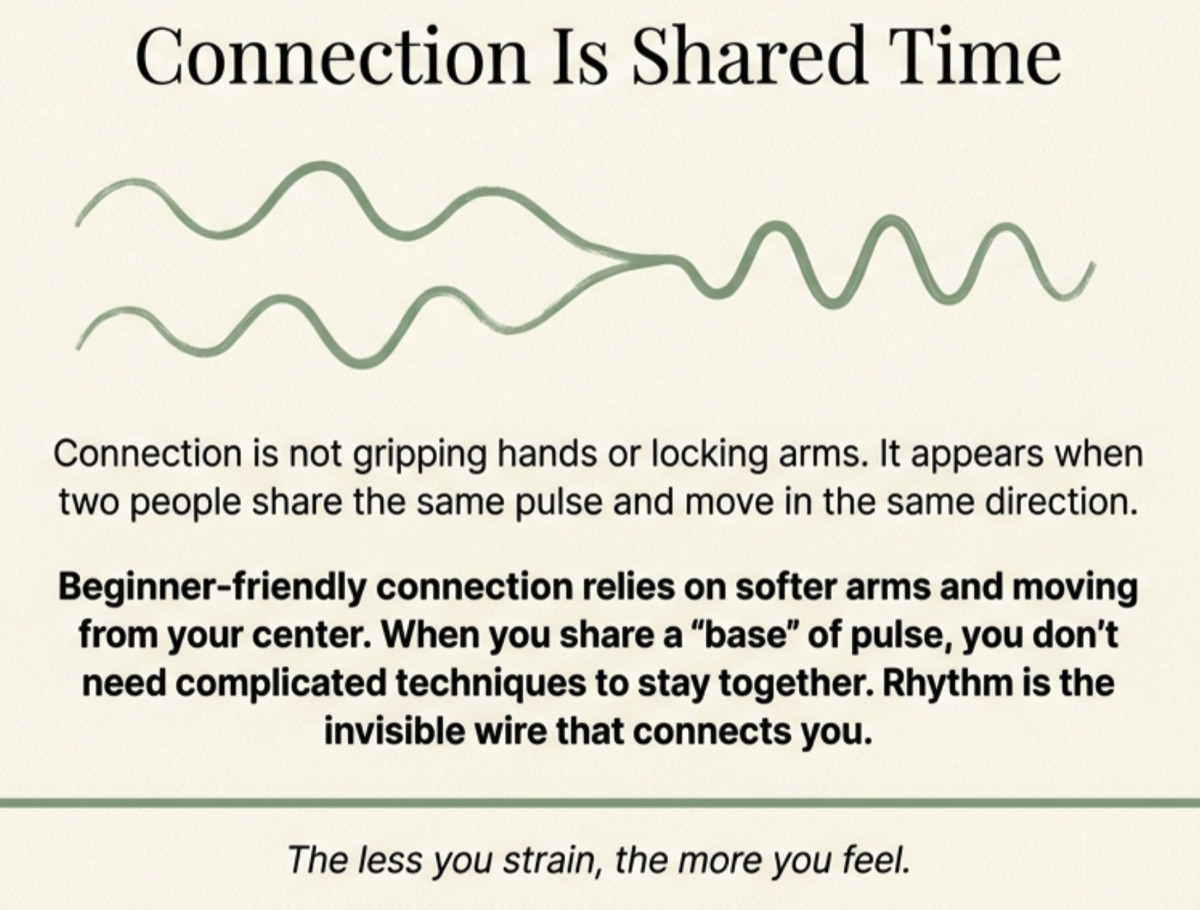
Connection in partner dance is not about squeezing hands or locking arms. It’s about sharing time and intention with another person. When you and your partner feel the same pulse and move in the same general direction at the same moment, connection appears—often with surprisingly little physical effort.
Beginner-friendly connection looks like softer arms, clear but small movements, and a calm center in your body. When you move from your center instead of just your arms, your partner can sense what’s coming without being yanked around. Small, intentional movements give both of you room to adjust and relax. The less you strain, the more you feel.
Pulse is the secret ingredient here. If both of you are grounded in the same pulse, you don’t need complicated techniques to stay together. Shared timing lets you relax into a common rhythm. From that shared base, everything—turns, pauses, simple walks—feels more connected and more human.
Step 11 Leading and Following as Listening Roles
Leading and Following as Listening Roles
Leading and following are often misunderstood as “one person in
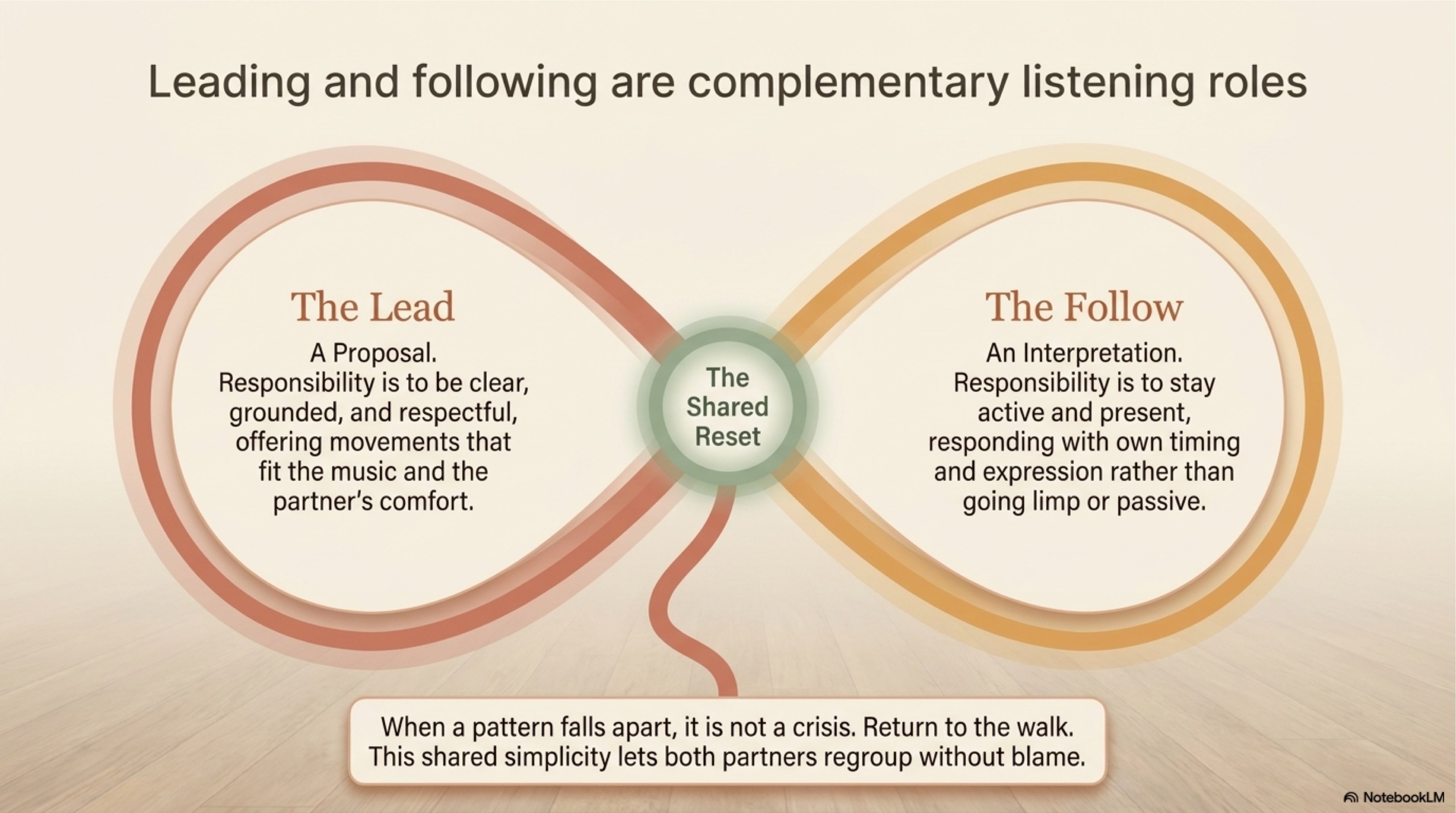
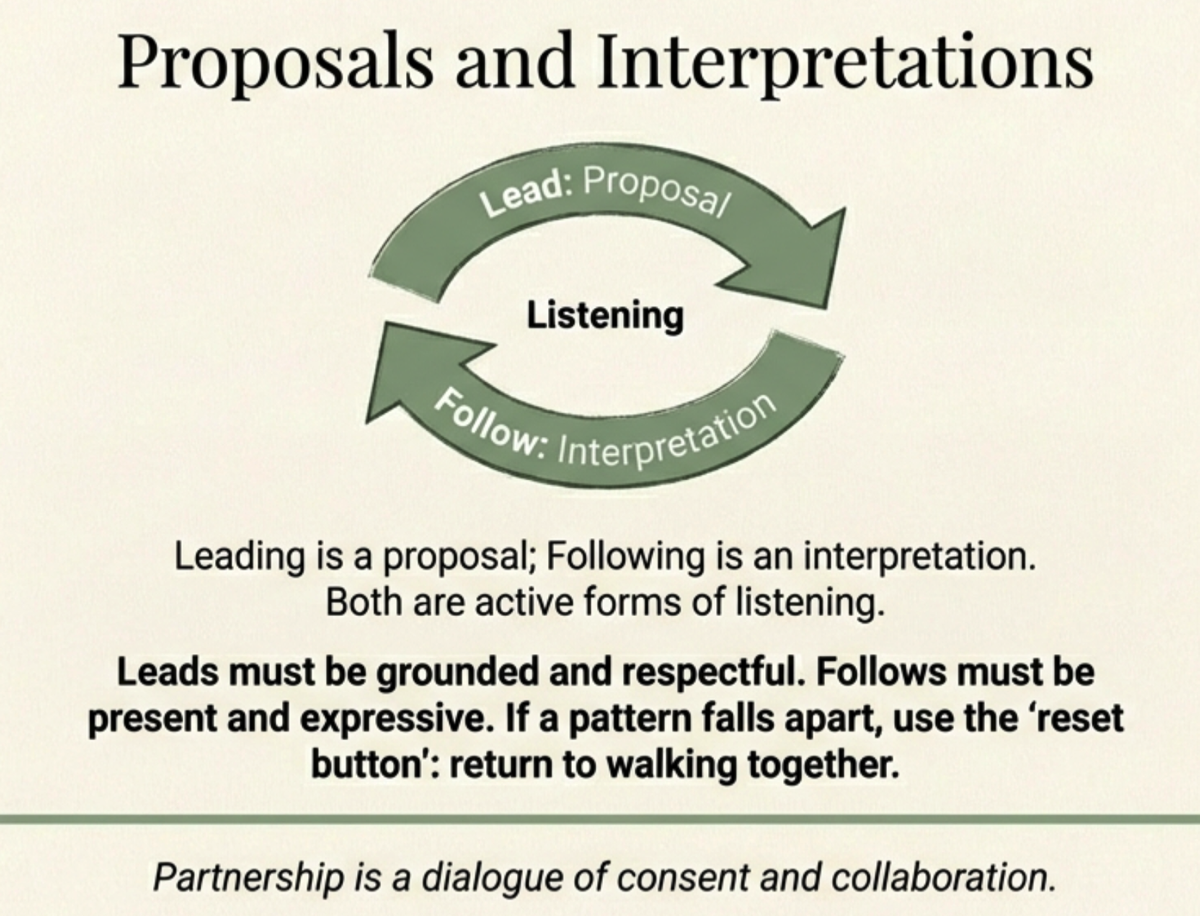
charge, one person obeying.” This series flips that script. A lead is a proposal. A follow is an interpretation. Both roles are ways of listening— to the music, to your own body, and to each other.
For leads, the responsibility is to be clear, grounded, and respectful: offer movements that fit the music and your partner’s comfort. For follows, the responsibility is to stay active and present: respond with your own timing and expression rather than going limp or passive.
Both partners share responsibility for clarity, comfort, consent, and musical agreement. When a pattern falls apart—as it will for everyone—that’s not a crisis. You have a shared reset: return to walking and phrasing, your common language. That shared simplicity lets you both regroup without blame. When both roles are listening and both know they can always go back to basics, partnership becomes playful and safe instead of stressful.
Step 12 The Culture of the Room
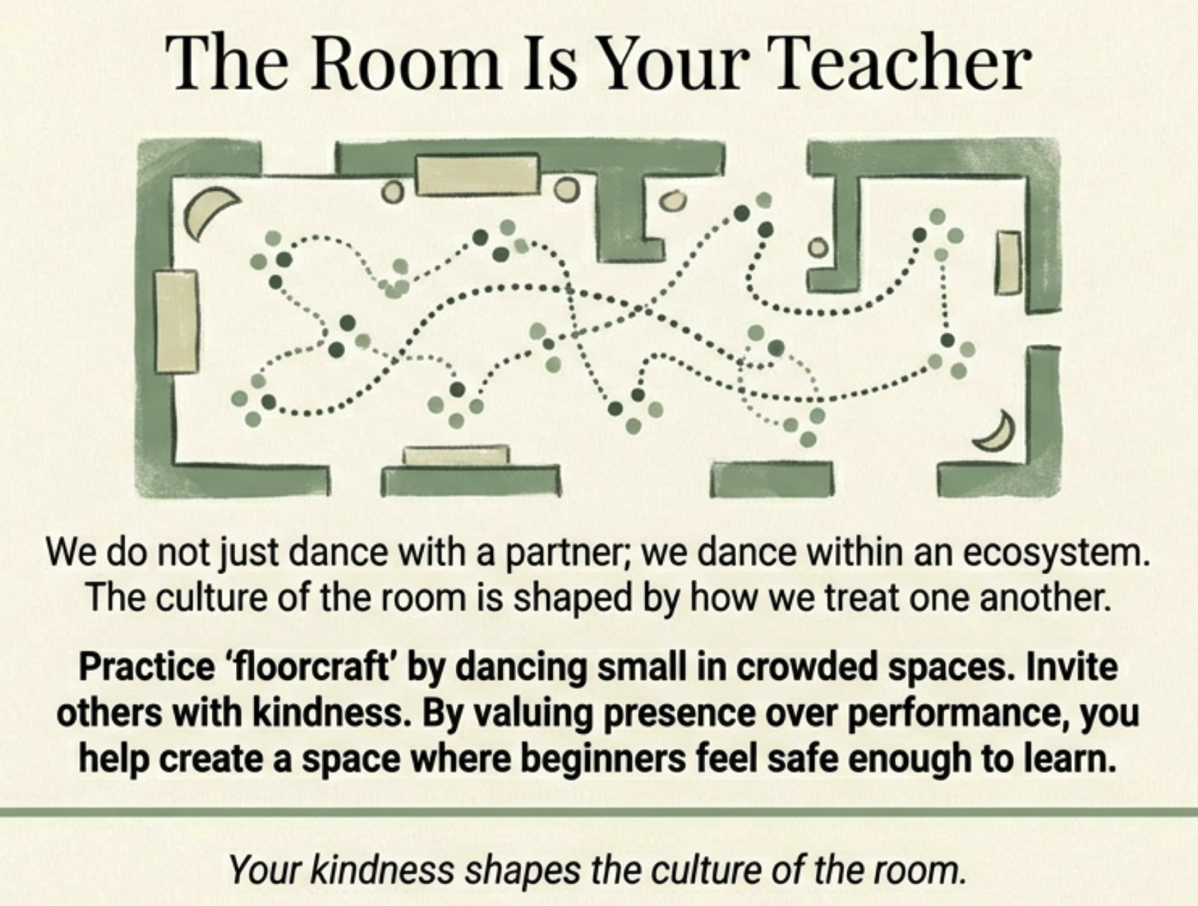
The Culture of the Room
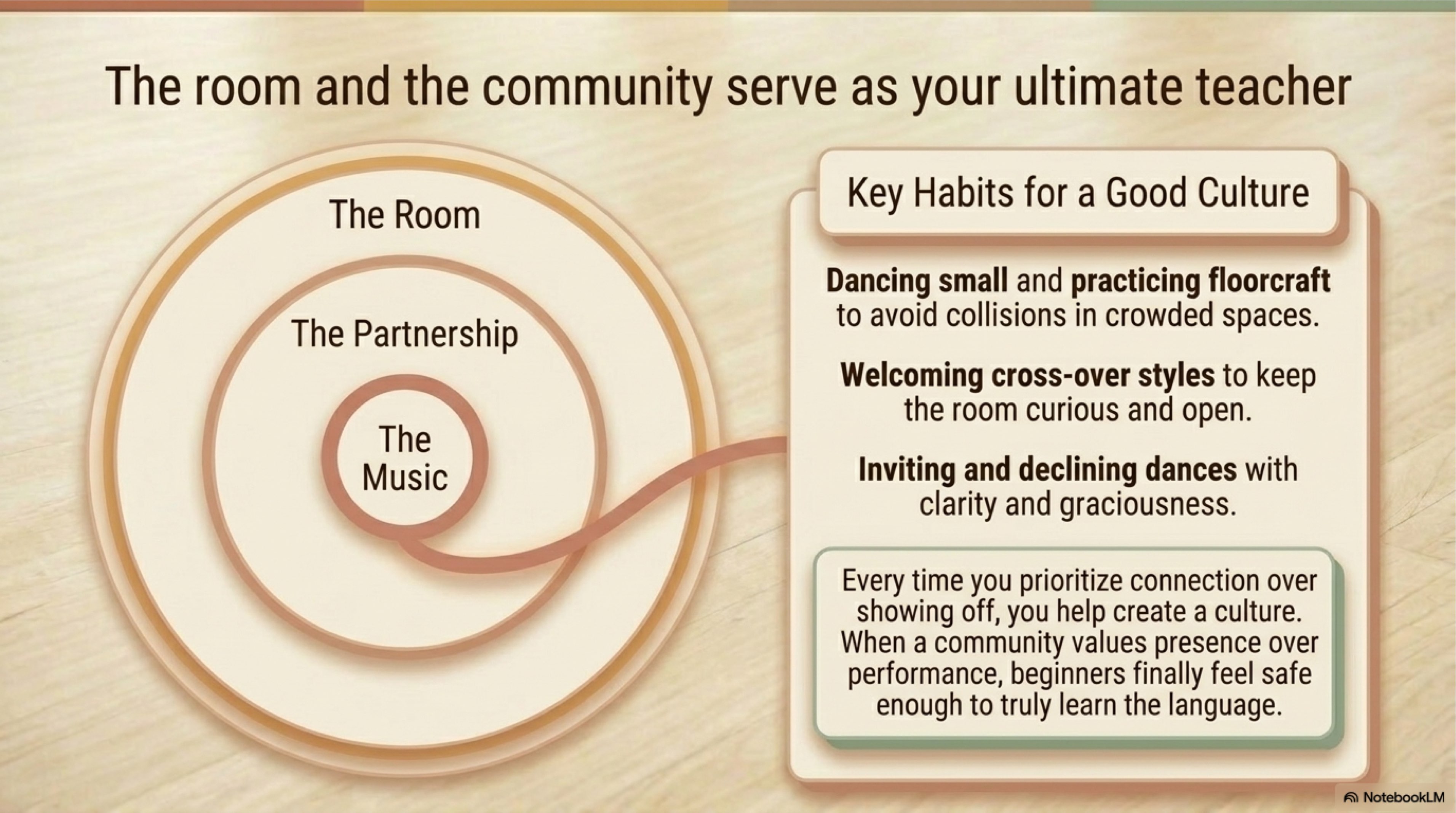
Finally, you’re not just learning steps; you’re stepping into a culture. How people move around each other, invite each other, and make space for beginners shapes your experience as much as any technique drill.
At Dance Eclectic, we treat the room- and the dancers themselves - as a teacher. Key habits build that culture: dancing small in crowded spaces, practicing floorcraft so you don’t collide with others, inviting people to dance with clarity and kindness, and being gracious when you decline or are declined.
Welcoming cross-over dancers from other styles keeps the room curious and open. Offering a supportive dance to someone new can change their whole night. When a community values presence over performance, beginners feel safe enough to actually learn. Every time you choose to be kind, to dance a little smaller to make space, or to prioritize connection over showing off, you’re helping to create a room where listening, moving, and connecting are possible for everyone.